
By Aryan Babariya | AryanOnSite
When we think about the foundations of modern civilization concrete rarely receives the same attention as artificial intelligence, smartphones or space technology.
Yet concrete is everywhere.
Our roads are made from concrete. Our bridges depend on concrete. Dams tunnels, metro systems, ports and buildings all rely on concrete.
Concrete is strong, versatile and relatively inexpensive.
Concrete has one fundamental weakness:
Concrete cracks.
That small crack can eventually become a much larger economic problem.
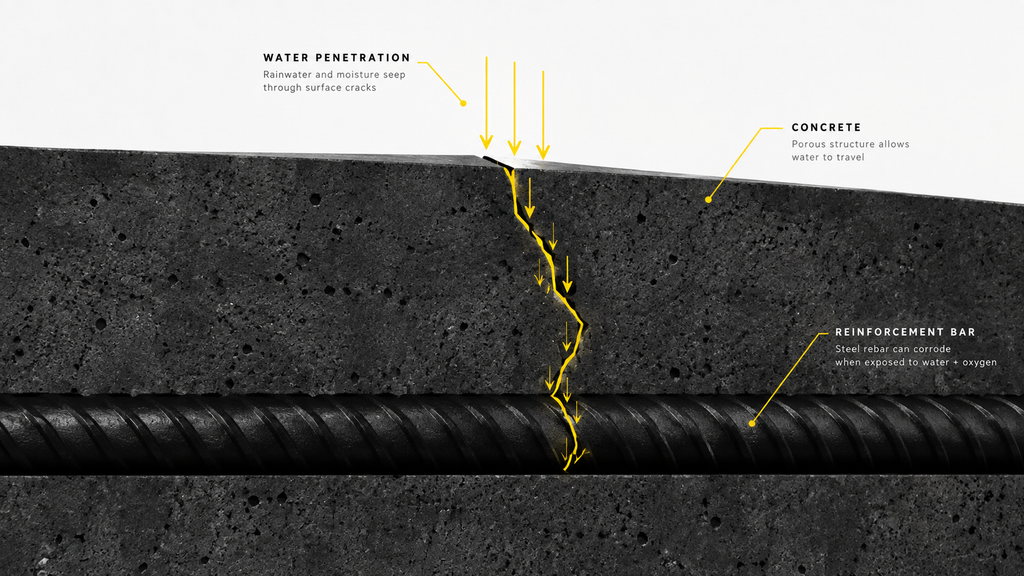
A crack can provide pathways for water and aggressive substances to enter the concrete. In concrete those substances can eventually contribute to corrosion of embedded steel reinforcement accelerating deterioration and creating the need for repair.
This creates an economic paradox.
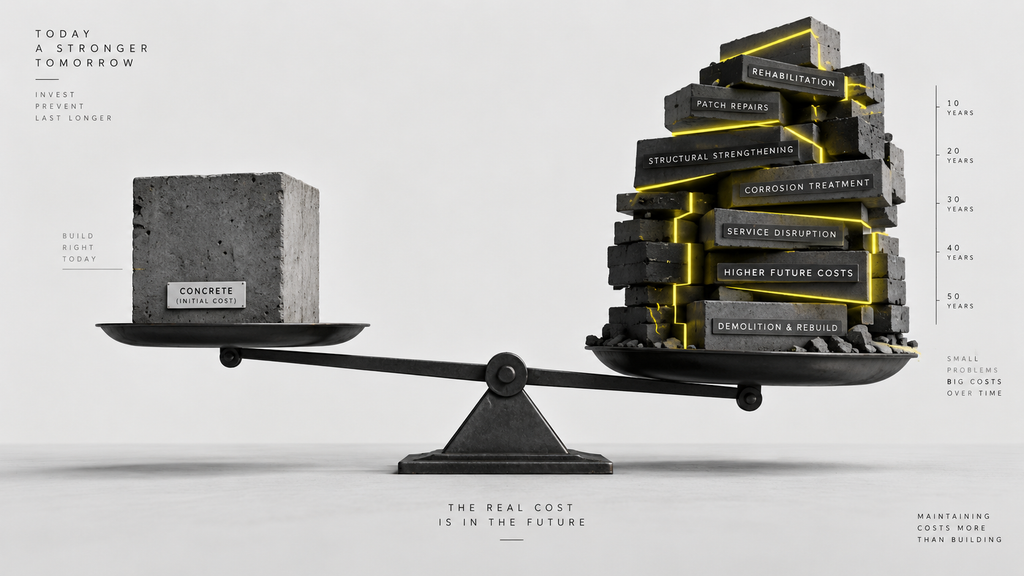
The material can be cheap to build with. Expensive to maintain.
That is where one particular number caught my attention:
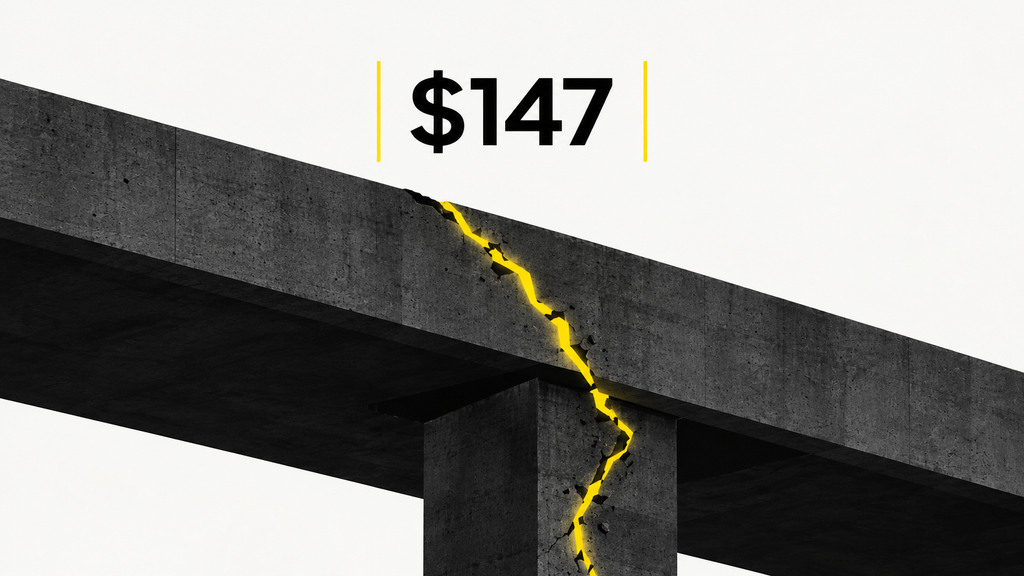
$147
The $147 Paradox
An article published by The Triple Helix at the University of Chicago discusses the problem surrounding conventional concrete and cites estimates of approximately $65–80 per cubic metre for concrete production compared with approximately $147 per cubic metre for repair and maintenance.
These figures should not be interpreted as a price for every concrete structure or country.
They illustrate a much bigger problem.
Imagine an equation:
Low initial construction cost → Cracking and deterioration → Inspection and maintenance → Repair → Repeated maintenance
The initial material cost is one part of the economic equation.
The other part is what happens over the decades after the concrete has been placed.
A 2021 review of self-healing materials similarly discusses the burden associated with concrete maintenance and cites production and maintenance cost estimates in the same general range.
This raises a question:
Are we sometimes optimising concrete for the construction cost rather than the lowest lifetime cost?
Why a Crack Is More Than a Crack
A crack does not automatically mean failure.
The problem is that cracks can change how the environment interacts with concrete.
Water can enter.
Chlorides can penetrate.
Oxygen can reach reinforcement.
In reinforced concrete corrosion can become a major durability problem.
Concrete is exceptionally strong in compression. Steel reinforcement is used to provide tensile capacity.
When reinforcement corrodes the corrosion products occupy volume than the original steel. This can generate stresses and contribute to cracking and deterioration.
The result is a chain reaction:
Cracking → Ingress of water and aggressive agents → Reinforcement corrosion → Deterioration → Repair
The economic consequences can extend far beyond the price of repairing one visible crack.
A bridge may require traffic restrictions.
A tunnel may require closure.
A water-retaining structure may require repair.
A large infrastructure project may require inspection, labour, equipment and extended downtime.
Suddenly the price of the concrete becomes only one small part of the equation.
The Lifecycle Cost Problem
Traditional construction often focuses heavily on the cost.
Infrastructure does not exist for one day.
A bridge could be expected to operate for decades.
A dam may remain in service for generations.
A tunnel may be expected to provide service for a large part of a city’s lifetime.
This means engineers increasingly need to think in terms of life-cycle performance.
Instead of:
Initial cost → Construction → Finished
the equation becomes:
Initial cost → Operation → Inspection → Maintenance → Repair → Rehabilitation → Replacement
A material that costs more initially could theoretically become cheaper over its lifetime if it substantially reduces deterioration and maintenance.
This is the argument behind many advanced concrete technologies.
Self-healing concrete is perhaps the most radical example.
What If Concrete Could Repair Its Own Cracks?
The idea sounds almost unrealistic.
Concrete cracks.
Instead of sending workers to repair it the material responds to the damage itself.
This is the concept behind self-healing concrete.
Self-healing is not one technology.
Researchers have investigated mechanisms, including:
- Autogenous healing
- Bacteria-based biomineralisation
- Polymer-based systems
- Encapsulated healing agents
- Fibre-assisted systems
- Crystalline and chemical healing mechanisms
A major 2023 review in Chemical Reviews examined these different strategies and their underlying mechanisms spanning experimental research and modelling across multiple scales.
The distinction between these technologies is important.
Some forms of concrete can heal cracks naturally through ongoing cement hydration and related chemical processes.
Others introduce a healing system designed to become active when damage occurs.
One of the well-known examples is bacteria-based concrete.
The Biological Solution
Researchers at Delft University of Technology developed a bacteria-based approach using spores and a lactate-based carbon source.
The concept is relatively elegant.
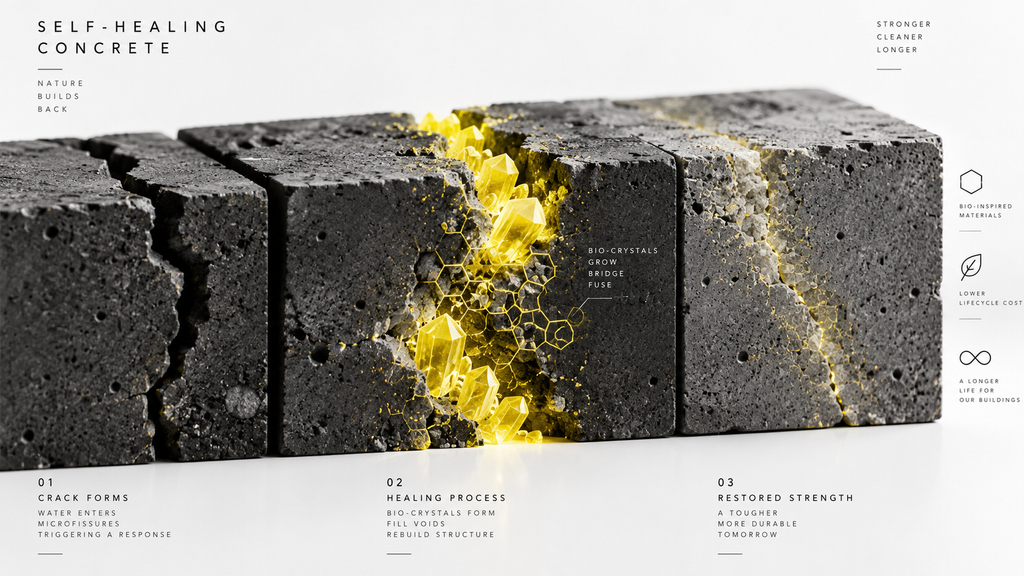
The bacterial spores remain dormant within the concrete.
When cracking occurs and water becomes available the biological system can become active.
The bacterial activity contributes to mineral precipitation, calcium carbonate.
That mineral can fill portions of the crack. Reduce pathways through the material.
Research by Wiktor and Jonkers at Delft University of Technology investigated bacteria with concrete, encapsulation techniques and the recovery of material functionality such as water tightness.
This changes the model.
Instead of:
Damage → External repair
the goal becomes:
Damage → Autonomous response → Reduced crack opening or permeability
That does not mean the structure becomes indestructible.
It means the material may be able to handle forms of damage without immediate human intervention.
The Real Economic Question
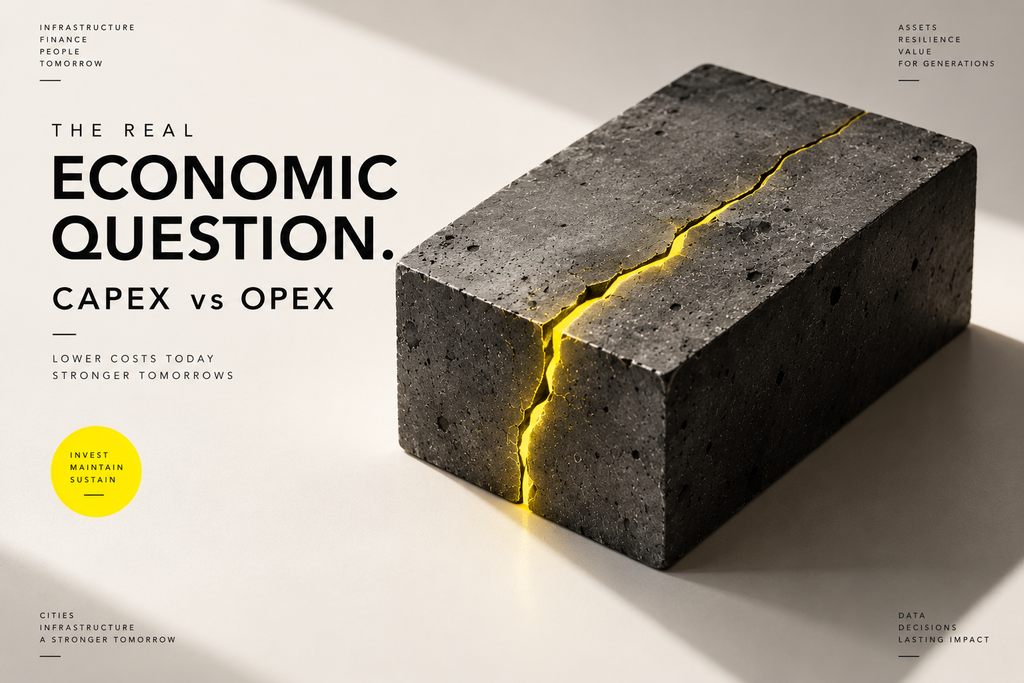
This is where the $147 figure becomes interesting.
Self-healing concrete will certainly cost more than ordinary concrete in many applications.
So why use it?
Because the correct comparison is not necessarily:
Concrete vs. Self-healing concrete
based only on their initial prices.
The better comparison is:
Lifetime cost of infrastructure
versus
Lifetime cost of infrastructure using self-healing technology
That includes:
- Initial material cost
- Construction
- Inspection
- Maintenance
- Repair
- Downtime
- Rehabilitation
- Expected service life
If self-healing technology adds ₹X to every metre but prevents ₹Y in future maintenance the technology could potentially make economic sense.
That relationship needs to be demonstrated with real data.
Where Could This Matter in India?
India provides an interesting environment for this question.
The country is rapidly expanding infrastructure across roads, bridges, metro systems, ports, tunnels and water infrastructure.
Some structures are also particularly expensive or difficult to repair.
Consider a bridge.
Closing a bridge is not simply a construction inconvenience.
It affects traffic.
It affects logistics.
It affects businesses.
It can affect a region.
Similarly repairing infrastructure or water-retaining structures can be significantly more complicated than repairing an ordinary building.
This creates a market for materials that can reduce the frequency or severity of maintenance.
That does not mean every concrete structure should use self-healing technology.
The economic case needs to be strongest where:
maintenance is expensive, access is difficult, downtime is costly or durability requirements are particularly demanding.
The $147 Question
The real lesson is not that every metre of concrete costs $147 to maintain.
It does not.
Construction costs vary dramatically according to geography, structure, materials, labour and exposure conditions.
The $147 figure is valuable because it illustrates a principle:
The cheapest material at the construction stage may not be the material over the entire life of a structure.
That changes how concrete innovation should be evaluated.
Instead of asking:
“How much does this concrete cost?”
we should ask:
“How much does this cost over 50 or 100 years?”
That is a harder question.
It requires materials science, structural engineering, economics and long-term performance data.
That is exactly where self-healing concrete becomes more than a futuristic idea.
It becomes an experiment.
The question is no longer simply whether concrete can heal itself.
It is whether healing concrete can ultimately cost less than repairing concrete.
Perhaps that is the real $147 problem.