
By Babariya | AryanOnSite
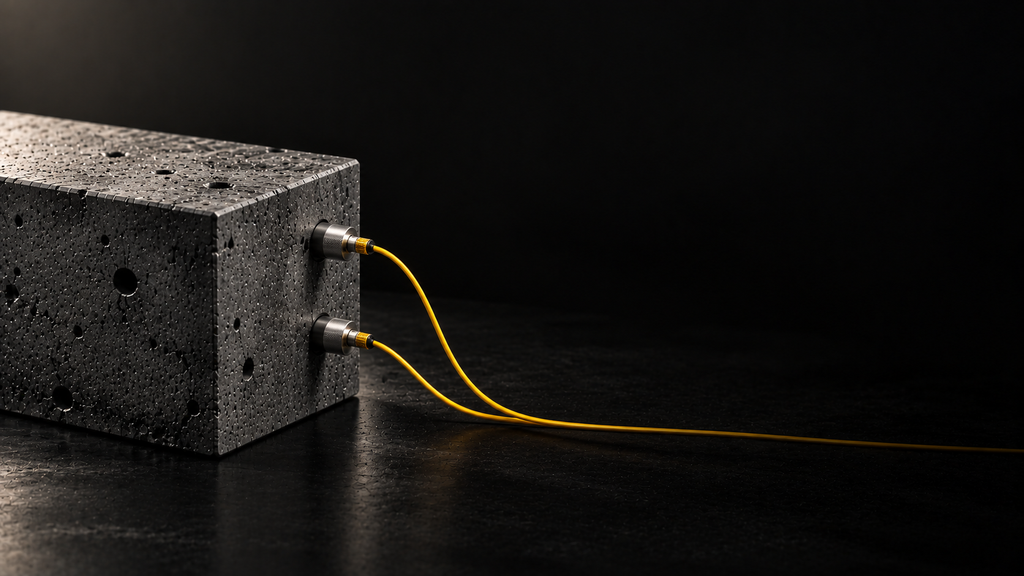
I have always thought that concrete is meant to do just one thing exceptionally well: carry loads.
It forms the skeleton of some of the structures humans build. Bridges carry thousands of vehicles each day buildings transfer loads through their columns and foundations dams hold back millions of litres of water and tunnels stay buried underground for decades. Yet despite its strength concrete has one weakness: engineers usually have to inspect it from the outside to understand what is happening inside it.
A crack may be visible. The processes that create it can start much earlier at a microscopic level. Small changes in stress, strain, internal cracking or deformation can happen before damage shows. Traditional structural health monitoring tries to solve this by installing sensors on or inside structures. But researchers are now looking at a different idea: what if the concrete itself could become the sensor?
This is the idea behind self-sensing concrete.
Of treating concrete and monitoring equipment as two separate systems researchers are adding electrically conductive parts to cement-based materials so the material’s electrical properties react to mechanical changes. When the concrete is compressed, stretched or damaged its internal conductive network can change, making a variation in electrical resistance. In words the material can give information about its own condition.
The idea sounds futuristic. It is not science fiction. Self-sensing cementitious materials have been studied experimentally for years. A large body of research now exists about their electrical behaviour, sensing mechanisms, conductive fillers, mechanical performance and potential structural applications.
The real engineering challenge is no longer just proving that the effect exists.
It is figuring out whether it can become reliable enough durable enough and economical enough for infrastructure.
When Concrete Becomes More Than a Structural Material
Conventional concrete is mainly designed around properties. Engineers care about strength, tensile behaviour, durability, permeability, shrinkage, creep and resistance to environmental conditions.
Self-sensing concrete adds another dimension: ** behaviour**.
The fundamental phenomenon behind much of this research is called piezoresistivity. In terms piezoresistive materials experience a change in electrical resistance when they undergo mechanical deformation.
Ordinary concrete does show behaviour but its conductivity is usually too low and its response too complicated to work as a practical sensor by itself. Researchers therefore add materials into the cementitious matrix. These materials create pathways through which electrical current can travel.
Some of the materials investigated include:
- Carbon fibres
- Carbon black
- Graphite
- Carbon nanotubes (CNTs)
- Graphene and graphene-based materials
- Carbon nanofibres
- Steel fibres and other conductive fibres
The goal is not just to make concrete conductive. The goal is to create a controlled network whose electrical properties respond predictably when the material experiences mechanical changes.
This distinction is extremely important.
A block of concrete that happens to conduct electricity is not necessarily a sensor. For self-sensing concrete to be useful there needs to be an repeatable relationship between a change in the material’s electrical response and a change in its physical condition.
That is where the materials science becomes particularly interesting.
What Happens Inside the Concrete?

To understand self-sensing concrete it helps to imagine the cement matrix at a scale.
Conductive particles or fibres are spread throughout the material. Depending on their concentration and distribution they can form a network of pathways.
Some conductive particles may be directly connected, while others can be separated by small gaps. When mechanical loading changes the structure of the concrete the distances, between conductive elements can also change.
When the concrete is compressed, for example some conductive pathways can become closer or more strongly connected. Under tension or damage other pathways can. Become disrupted.
The overall electrical resistance of the material therefore changes.
A simplified representation is:
loading → internal deformation → conductive network changes → electrical resistance changes → measurable signal
That signal can then potentially be interpreted to determine whether the concrete has experienced a change in stress, strain or damage.
This is where self-sensing concrete differs fundamentally from embedding a conventional sensor into concrete.
With a sensor the sensor is a separate component installed into the structure.
With self-sensing concrete the structural material itself participates in the sensing process.
The Percolation Problem
One of the important concepts in this field is electrical percolation.
Imagine adding an amount of conductive material to concrete. If there are a few conductive particles scattered throughout the cement matrix most of them will be isolated from each other. There will not be continuous pathways for electricity to travel efficiently.
As the concentration of material increases the particles become increasingly connected.
Eventually an interconnected conductive network forms.
This region is associated with the percolation threshold.
It is important because self-sensing behaviour can become particularly sensitive around this range. Small changes in the arrangement of conductive particles can produce noticeable changes in electrical resistance.
This also creates an engineering balancing act.
Adding conductive material does not automatically make the concrete better.
Researchers have to consider:
- conductive filler concentration
- particle or fibre distribution
- dispersion quality
- strength
- workability
- durability
- electrical sensitivity
- cost
- compatibility with conventional concrete production
The ideal material therefore has to perform two jobs simultaneously.
It must remain a structural material while also behaving like a reliable sensing material.
The Materials Behind the Concept
Carbon Fibres: Strength and Conductivity Together
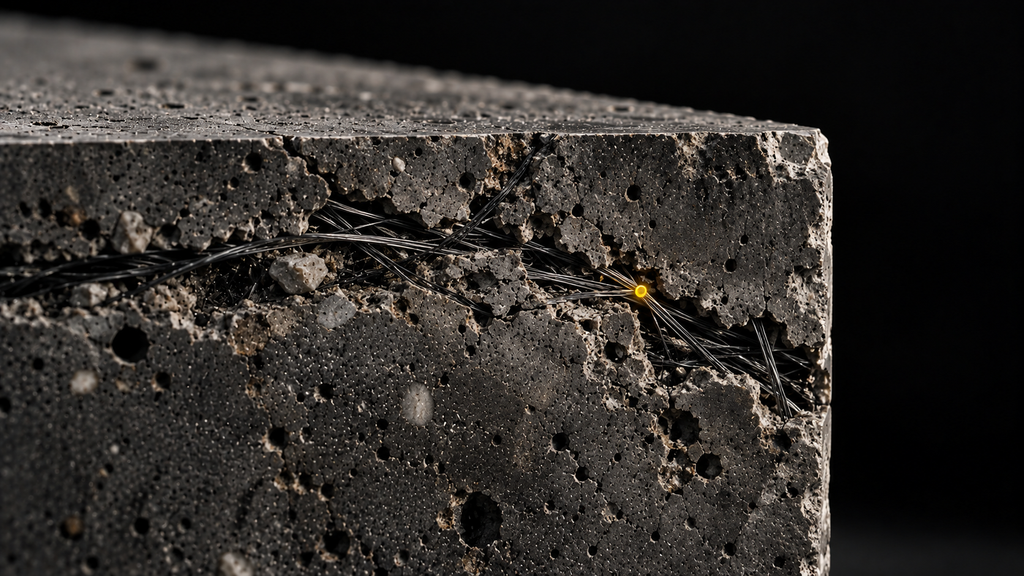
Carbon fibres are among the interesting materials investigated for self-sensing cementitious composites because they can contribute to both mechanical reinforcement and electrical conductivity.
When distributed through a matrix carbon fibres can create conductive pathways. Changes in the fibre network caused by deformation can then produce measurable electrical responses.
Their fibre form also provides an advantage over adding a conductive powder: a relatively small amount of fibre can potentially create connections across larger distances within the material.
However fibre-based systems introduce their challenges. Fibres need to be distributed throughout the mixture rather than forming clusters. Their concentration also affects workability and mixing behaviour.
This creates a question for large-scale construction:
Can a material designed in a controlled laboratory environment maintain the same sensing behaviour when produced in a real concrete plant?
Carbon Black: Tiny Particles, Large Effects

Carbon black is another material investigated for cement-based composites.
Unlike fibres, carbon black consists of extremely small carbon particles. When enough particles are incorporated into the matrix they can form conductive networks.
Its small particle size can be useful for creating a number of conductive pathways but it also makes dispersion important.
If the particles do not distribute properly the electrical behaviour can become inconsistent.
This illustrates one of the recurring problems in self-sensing concrete: the sensing performance depends heavily on microstructure.
Two concrete samples with the nominal mixture may not necessarily behave identically if the conductive material is distributed differently.
Carbon Nanotubes and Graphene
At the nanoscale the possibilities become more interesting.
Carbon nanotubes are small carbon structures with excellent electrical conductivity and very high aspect ratios. Graphene and graphene-based materials have also attracted attention because of their electrical and mechanical properties.
Their small dimensions mean that they can interact with the cement matrix at scales smaller than conventional fibres.
This makes them attractive for sensing small changes.
Nanoscale materials introduce one of the fields biggest practical problems:
dispersion.
Nanomaterials have a tendency to cluster together. If they form agglomerations instead of being distributed throughout the cement matrix the resulting electrical network may not behave as intended.
Researchers therefore investigate methods such as functionalization, surfactants, mixing techniques and dispersion processes to improve their distribution.
This is an example of the difference between discovering a material and engineering it for construction.
A material can have properties, in a laboratory and still face enormous challenges before it can be mixed into millions of tonnes of concrete.
What Can Self-Sensing Concrete Actually Detect?
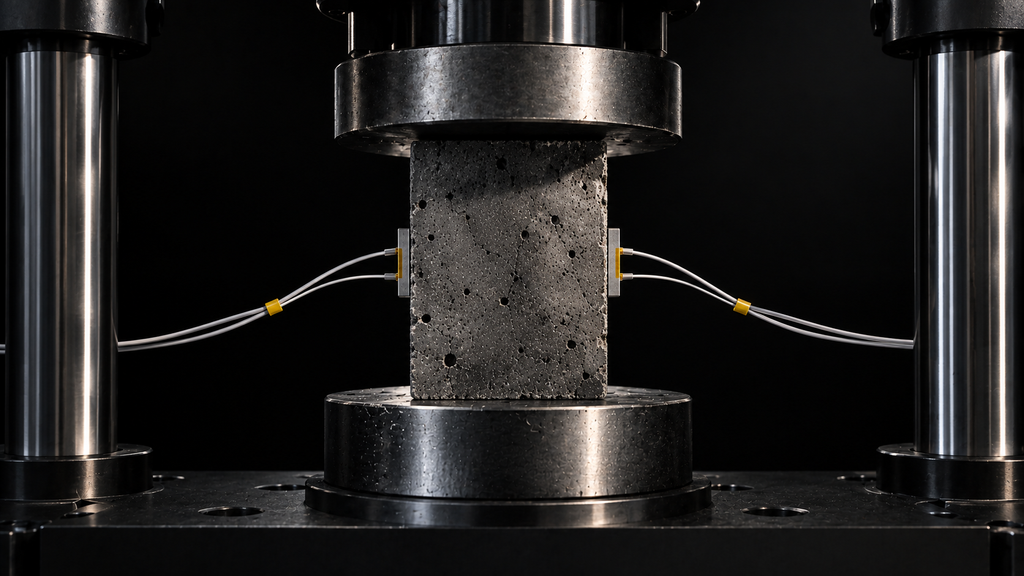
The potential applications go beyond just spotting cracks.
Because electrical resistance can change when the material is deformed researchers have looked at self-sensing materials for several kinds of structural monitoring.
- Strain monitoring: detecting changes in deformation when load is applied.
- Stress monitoring: identifying changes that happen when the structure is loaded.
- Damage detection: identifying changes in material behaviour that happen when cracking or deterioration occurs.
- Structural health monitoring: continuously watching for changes in structural components.
- Traffic monitoring: detecting responses to loads on roads and bridge structures.
- Seismic monitoring: measuring how the structure responds during loading.
- Monitoring: investigating electrical changes that happen during deterioration processes.
The important point is that self-sensing concrete does not have to replace every sensor.
In some situations its greatest value could be as a distributed sensing material.
Of having a few sensors at specific spots large areas of a structure could become electrically responsive.
That could change how engineers think about monitoring.
From a Single Sensor to a Sensing Structure
Consider a bridge.
A conventional monitoring system might put sensors at chosen places: near supports, critical joints, beams or other spots where engineers expect major structural responses.
This gives information but it also means the monitoring system depends on where sensors are installed.
Self-sensing introduces another possibility.
If the concrete itself can produce a response, a much larger volume of material could take part in monitoring.
Of asking:
“Where should we put the sensor?”
engineers could eventually ask:
“How can we make the structure itself act as a sensing network?”
That is a bigger idea.
However it is also where the engineering becomes more complicated.
The Problem With Reading the Signal

One of the misconceptions about self-sensing concrete is that finding an electrical change automatically tells engineers exactly what happened.
It does not.
Suppose a concrete element shows a change in resistance.
What caused it?
It could be:
- loading.
- Cracking.
- Temperature variation.
- Moisture changes.
- Changes in the network.
- Environmental conditions.
- Electrical measurement differences.
- Long-term material changes.
This means the electrical signal cannot be simply interpreted without context.
Researchers therefore study the relationship between response and mechanical behaviour under controlled conditions.
One major challenge is sensitivity.
Concrete. Releases moisture. Temperature changes during the day and across seasons. Both moisture and temperature can affect properties.
Therefore a real-world self-sensing system needs to distinguish between:
“The concrete is changing because the environment changed.”
“The concrete is changing because something is structurally wrong.”
That distinction could decide if the technology is useful in infrastructure.
The Calibration Challenge
A laboratory specimen can be tested under controlled conditions.
Engineers know the load, temperature, moisture and geometry. They can carefully measure how the electrical response changes.
Real structures are much messier.
A bridge experiences:
- Changing traffic loads.
- Weather.
- Temperature cycles.
- Humidity.
- Vibration.
- Long-term creep.
- Shrinkage.
- Aging.
- Repeated loading.
A self-sensing system would therefore need to understand what normal behaviour looks like before it can spot behaviour.
This creates a layer of engineering beyond the material itself.
The concrete needs to produce a signal.
The monitoring system then needs to interpret that signal
That is why self-sensing concrete sits at the intersection of materials science, structural engineering, engineering and data analysis.
Stronger. Smarter Concrete?
This leads to a question.
For decades the development of concrete has mainly focused on making it stronger durable and more resistant, to environmental conditions.
Perhaps the next step is not simply:
How strong can concrete become?
It could also be:
How information can concrete provide about itself?
A material that is a little stronger and gives no information about its condition behaves very differently from a material that can continuously provide structural data.
Imagine two bridge components.
The first has concrete and requires periodic inspections.
The second uses a self-sensing material capable of producing electrical information about its deformation.
The second material is not necessarily stronger.
The self-sensing concrete could potentially be more informative.
That distinction may become more important as infrastructure becomes more connected and data-driven.
Why Isn’t Every Building Made With It Yet?

If the technology has already been demonstrated in research why don’t we see self-sensing concrete?
Because proving a concept in a laboratory and integrating it into the construction industry are two different problems.
Several major barriers remain.
1. Material consistency
A self-sensing concrete needs electrical behaviour. Large-scale concrete production introduces variability in mixing, moisture, aggregate distribution and conductive filler dispersion.
2. Cost
Specialized conductive materials can be more expensive than concrete ingredients. For adoption the additional monitoring value must justify the additional material and processing costs.
3. Durability
Concrete structures are expected to survive decades. Self-sensing concrete therefore needs to maintain electrical behaviour over long periods not just during laboratory experiments.
4. Environmental effects
Temperature and moisture can influence resistance making signal interpretation more difficult.
5. Standardization
Construction relies heavily on established standards for material testing, structural design and quality control. Self-sensing concrete needs reliable testing procedures and acceptance criteria.
6. Electrical infrastructure
Self-sensing concrete still needs a way to measure, transmit and interpret its response.
That introduces another layer of equipment and engineering.
7. Data interpretation
A resistance change is only useful if engineers can determine what caused it and whether it represents a structural concern.
These challenges explain why the technology remains a research area rather than a standard construction material.
The Bigger Opportunity: Distributed Structural Health Monitoring
The interesting future of self-sensing concrete may not be replacing every conventional sensor.
It could be combining material-based sensing with structural health monitoring.
Imagine a bridge containing conventional high-precision sensors at critical locations while large portions of its concrete also provide distributed electrical information.
The conventional sensors could provide measurements at specific points.
The self-sensing concrete could provide information across larger regions.
Together these systems could potentially create a more complete picture of structural behaviour.
This could also connect self-sensing concrete with emerging construction technologies such as Internet of Things systems, digital twins and artificial intelligence.
That is an important distinction:
The self-sensing concrete is not the entire monitoring system.
It is the layer that produces information.
The sensors and electronics measure it.
The data system stores it.
Analytical models interpret it.
Engineers ultimately decide what action should be taken.
From Smart Material to Smart Infrastructure
This is perhaps the most important idea behind self-sensing concrete.
The technology is not interesting simply because concrete can conduct electricity.
It is interesting because it challenges the boundary, between structure and sensor.
For decades construction has largely followed a model in which a structure is built first and monitoring equipment is added afterward.
Self-sensing materials suggest another possibility:
What if monitoring capability could be designed into the material from the beginning?
That could eventually change how engineers approach health monitoring.
Of thinking of sensors as equipment attached to a structure they could begin thinking about materials as part of the information system of a structure.
The implications go beyond concrete.
The same general philosophy could influence research into cementitious materials, conductive composites, sensing pavements and multifunctional construction materials.
The building material would no longer simply have a function.
It could have a function as well.
The Scale-Up Question
The important question surrounding self-sensing concrete is not:
“Does it work?”
Research has already shown that self-sensing behaviour can happen.
The difficult question is:
Can we make it work reliably at construction scale?
A laboratory sample might be mixed carefully tested and watched under controlled conditions.
A highway, a bridge or a skyscraper is entirely different.
Thousands of metres of concrete might have to be made with the same properties. The concrete must be moved, put down pressed and let cure in life. The sensing reaction must stay useful during the life of the structure.
That is the bottleneck when we scale up.
It is probably where the most important research still has to happen.
The future of self-sensing concrete may not rely on finding another nanomaterial.
It may depend on solving more practical questions:
How do we manufacture it consistently?
How do we calibrate it?
How do we interpret its signals?
How long does its sensing ability remain reliable?
Most importantly does the information it provides justify the additional complexity and cost?
A Different Definition of “Smart Concrete”
The construction industry has used the word “smart” more and more to describe materials.
A material is not truly useful just because it sounds futuristic.
A smart construction material should give an engineering advantage.
Self-sensing concrete offers an idea because it tries to mix two functions that have usually been separate:
structural performance and structural information.
The concrete must still carry loads.
It must still survive exposure.
It must still be economical and buildable.
If it can also give information about its own mechanical state it could become part of a totally different way to monitor infrastructure.
Of waiting for a structure to show visible signs of wear engineers could get information from the structure much earlier.
That does not stop inspections.
It does not stop engineers.
It definitely does not mean that concrete can diagnose every structural problem on its own.
What it does give is another layer of information.
When the Material Becomes the Sensor

Concrete has normally been treated as a material.
It carries loads resists forces and stays in place while engineers look at it from the outside.
Self-sensing concrete challenges that idea.
By adding materials like carbon fibres, carbon black, carbon nanotubes and other conductive fillers researchers have shown cementitious materials that can change their electrical response when they are mechanically changed.
The idea joins materials science and structural monitoring in a way that could change how we think about infrastructure.
The way from laboratory experiment to a bridge or building is not simple.
The material must be consistent. Its electrical response must stay measurable over time. Environmental effects must be understood. The signals must be interpreted correctly. Production must be affordable. Engineers must have reliable ways to turn electrical measurements into useful structural information.
Those challenges are why the technology is worth studying.
The future of concrete may not just be about making it stronger.
It may be about making it more aware.
Maybe one day when a bridge starts showing changes deep inside the first warning will not come from a visible crack or a scheduled inspection.
It could come from the concrete itself.