
Published on AryanOnSite.com
By Aryan Babariya
the concept
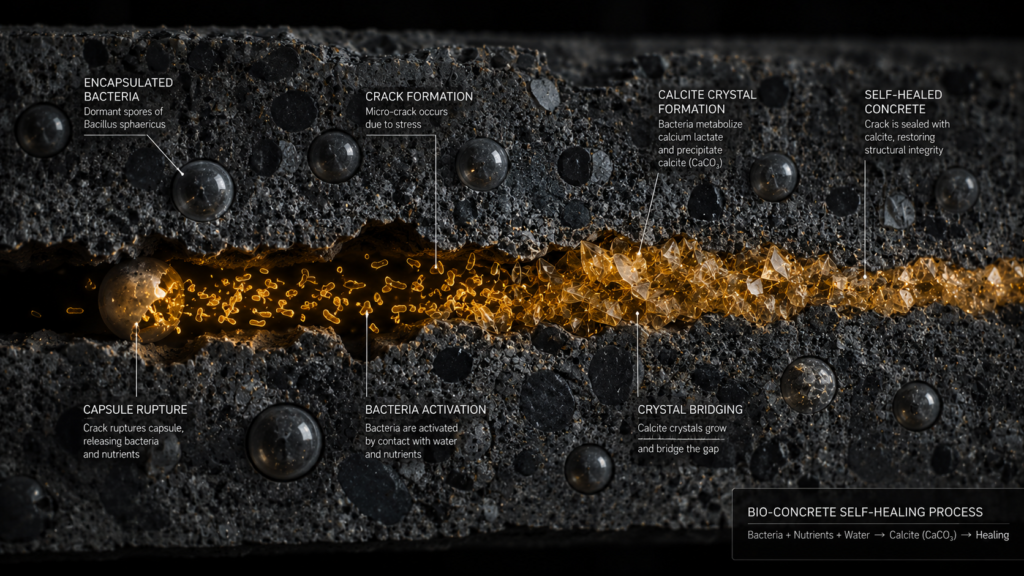
Think about a bridge that could fix its own cracks.
Every year, roads, bridges, tunnels, dams, and buildings need a huge amount of upkeep because concrete always cracks. Concrete is really strong when squeezed, but it’s also fragile. Even small cracks let water, salts, and chemicals get in and reach the steel inside.
Once that happens, rust can start, weakening the structure and making it not last as long.
But what if concrete could deal with damage before it became a big problem?
That’s the idea behind self-healing concrete. It’s a new construction technology that mixes engineering, microbiology, and materials science to help concrete fix some cracks by itself.
One of the coolest ways to do this uses something you wouldn’t expect to find in a bridge:
sleeping bacteria.
Concrete’s Biggest Weakness Starts With a Tiny Crack
Concrete cracks for many reasons. Some are caused by the material itself, others by the environment or the stress on a structure.
Common reasons include:
- Drying out as concrete loses water
- Expanding and shrinking with temperature changes
- Repeated traffic and stress from the structure
- Earthquakes and vibrations
- Freezing and thawing in cold places
- Rusting of the steel inside
- Chemicals like salt, seawater, and other harsh stuff
A small crack might not seem like a big deal at first. But it can let water and chemicals go deeper into the concrete.
This is especially important for concrete with steel reinforcement.
When water and oxygen reach the steel, it can rust. The rust takes up more space than the original steel, creating pressure that can cause more cracking and damage.
This creates a loop:
Crack → Water gets in → Steel rusts → Concrete breaks down → Crack gets bigger
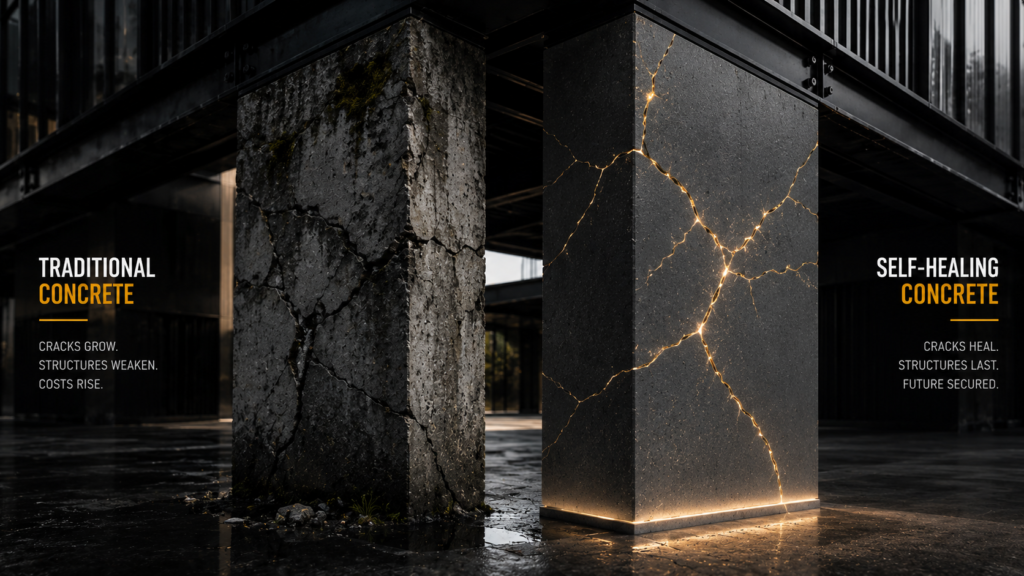
Regular repairs like injecting material into cracks, patching, or using sealants can stop this, but they need checking, work, equipment, and regular upkeep.
So, engineers started asking a different question:
What if the concrete could fix the crack itself?
Meet Self-Healing Concrete
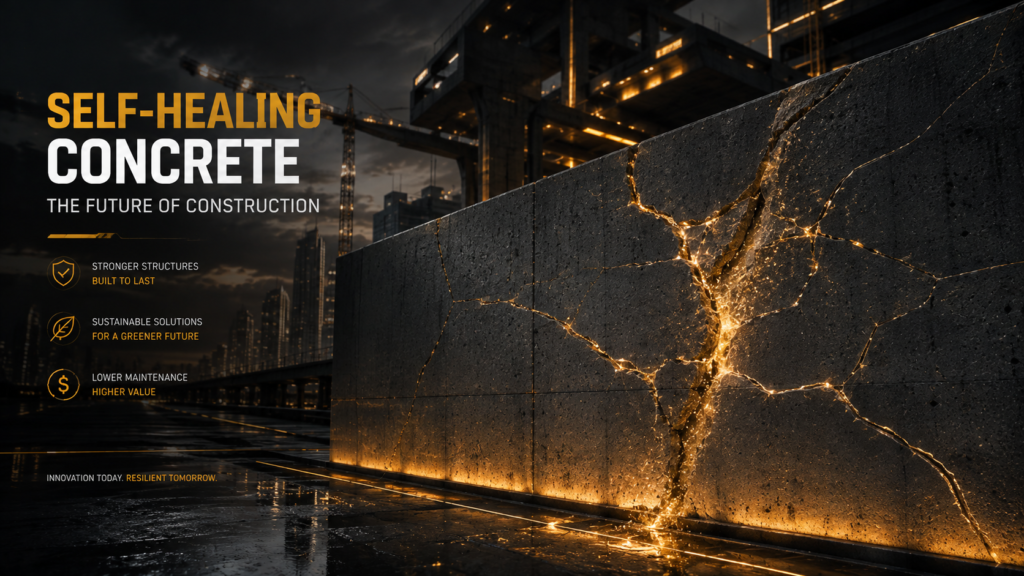
Self-healing concrete is designed to automatically fix certain cracks without people needing to do anything.
There are two main ideas behind how concrete heals.
Natural healing is what regular cement-based materials can do to partially seal small cracks. This happens through ongoing cement hydration and the formation of calcium carbonate.
Engineered healing, on the other hand, is built into the concrete using extra healing materials like bacteria, capsules, or special networks.
The bacteria method is especially interesting because it essentially turns concrete into a tiny biological repair system.
The Bacteria That Sleep Inside Concrete
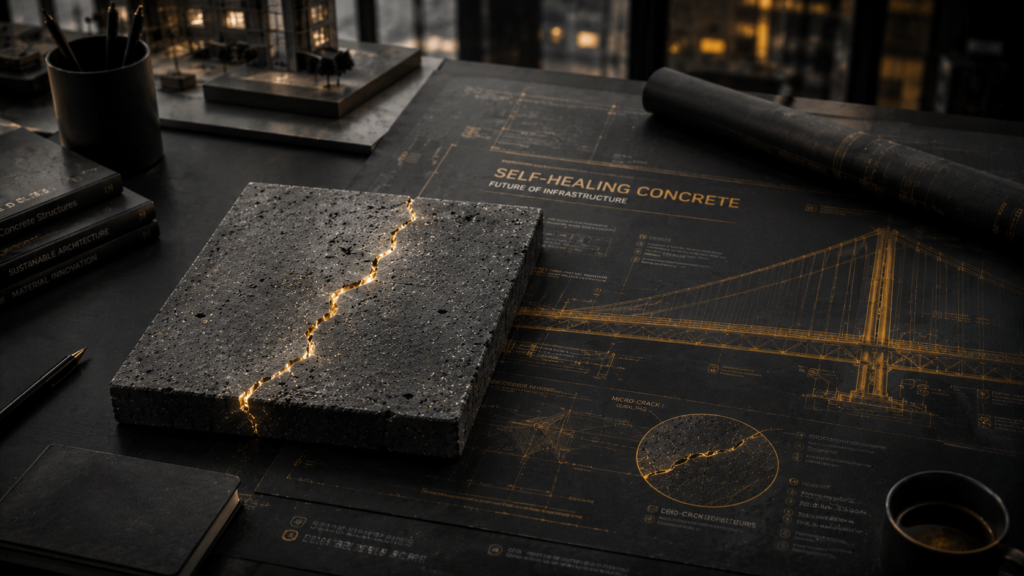
One well-known method uses bacteria that can handle alkaline conditions, like certain species of Bacillus.
But there’s a problem.
Concrete is a very tough environment for most living things. It’s very alkaline, has very little water, and can have big changes in temperature and pressure.
So how can bacteria survive inside it?
The answer is bacterial spores.
Spores are dormant forms that let certain bacteria survive tough conditions. They can stay inactive in the concrete until the conditions are right for them to become active.
Some systems also provide food, like calcium lactate, which the bacteria can use when they wake up.
And then a crack forms.
When Water Enters, the Concrete Comes Alive
Imagine a tiny crack forming inside a concrete structure.
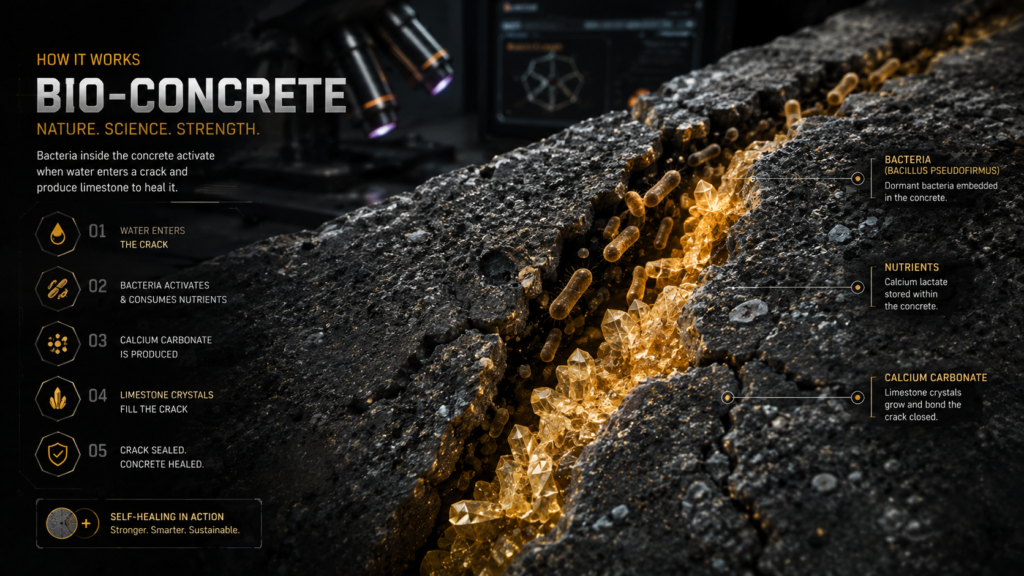
The crack lets water flow in.
That moisture can wake up the dormant bacterial spores.
Once awake, the bacteria eat the nutrients they have and help create calcium carbonate (CaCO₃).
Calcium carbonate is the same main mineral found in things like limestone.
The new mineral slowly fills the crack, helping to seal it and making it harder for water to get in.
Basically:
Crack forms → Water gets in → Bacteria spores wake up → Calcium carbonate forms → Crack gets sealed
It’s almost like having tiny repair workers hidden inside the concrete, just waiting for damage to happen.
This process isn’t magic, and it doesn’t mean bacteria can rebuild a totally destroyed bridge. The technology is mostly meant for small cracks, where sealing them can help prevent further damage.Your Attractive Heading
Bacteria Aren’t the Only Repair Crew
Even though bacteria concrete gets a lot of attention, researchers are developing other self-healing technologies too.
🦠 Bacterial Self-Healing
Bacteria like Bacillus pseudofirmus can help calcium carbonate form inside cracks.
Healing agent: Bacteria + nutrients
Main product: Calcium carbonate
💊 Capsule-Based Healing
Some concrete has tiny capsules filled with polymers, glues, or other healing materials.
When a crack hits a capsule, it can break and release the healing material into the damaged area.
The material then hardens or reacts to seal the crack.
Healing agent: Polymer or chemical liquid
Trigger: Capsule breaking
🩸 Vascular Healing Systems
These systems are inspired by the human body’s blood vessels.
Instead of blood, networks of tiny channels can carry healing materials to damaged spots.
When a crack forms, the system can send the needed material to the damaged area.
Healing agent: Liquid repair material
Inspiration: Blood vessels
🔥 Shape-Memory Materials
Researchers are also looking at materials that remember their shape and can react to temperature changes.
When activated, these materials can move to help close or shrink cracks.
These methods are still being developed, but together they show how engineers are moving beyond just making concrete stronger.
They are trying to make it react to damage.
Why Does Self-Healing Concrete Matter?
The biggest benefit is simple:
A structure that can slow down its own damage might need fewer repairs.
This could have a big impact on infrastructure.
Possible benefits include:
- Less need for maintenance
- Longer lifespan
- Better durability
- Less water and chemical getting in
- Potentially lower costs over its life
- Less environmental impact
The sustainability point is really important.
Making cement creates a lot of the world’s carbon dioxide emissions. If infrastructure can stay usable for longer, less will be needed for rebuilding, replacing, and major repairs.
So, self-healing concrete isn’t just about making concrete cool.
It could be part of a bigger move towards infrastructure that lasts longer and uses resources more efficiently.
From Bridges to Underwater Structures
This technology could be useful anywhere cracks are hard, expensive, or dangerous to fix.
🌉 Bridges
Bridges constantly face stress from use, vibrations, temperature changes, and exposure to rain and salt.
Self-healing concrete could help manage small cracks before they become bigger problems.
🚇 Tunnels and Metro Systems
Repairing underground structures can be tricky because they’re hard to reach, and shutting down transport is costly.
🌊 Marine Structures
Ports, seawalls, and offshore structures are always in contact with seawater and salt, making durability extra important.
💧 Dams and Water Infrastructure
For structures meant to hold water, controlling cracks and reducing leaks is vital.
🏙️ High-Rise Buildings
Buildings experience temperature changes, wind movement, and long-term stress, creating situations where crack control is valuable.
The key is accessibility.
The harder a structure is to check and repair, the more valuable automatic damage-management technologies could become.
The Technology Still Has a Few Cracks of Its Own
Self-healing concrete sounds like the future, but it’s not perfect yet.
1. Cost
Special bacteria, nutrients, capsules, and other healing systems can make the initial cost higher than regular concrete.
2. Crack Size
Self-healing systems usually work best on small cracks. Big structural damage can’t just be left for bacteria to fix.
3. Long-Term Performance
Researchers still need to figure out how different bacteria systems perform over many years in real conditions.
4. Manufacturing and Construction
Adding healing materials to concrete while keeping its strength, workability, and durability can be tough.
5. Real-World Scaling
A material that works well in a lab still needs to prove it can perform reliably on large construction projects.
These challenges mean self-healing concrete won’t replace regular concrete anytime soon.
But the research is moving fast.
From Smart Materials to Smart Infrastructure
The most exciting idea isn’t just concrete that heals.
It’s the concept of infrastructure that can sense, react, and adapt to damage.
Researchers are combining self-healing materials with things like sensors, nanotechnology, structural monitoring, and artificial intelligence.
Imagine a future bridge that can:
Detect a crack → Watch it grow → Start a healing process → Confirm the repair
This would be a big change in how engineers think about infrastructure.
Instead of designing structures that just resist damage, engineers could design structures that respond to it.
The Future Isn’t Just Stronger. It’s Smarter.
Concrete has been one of humanity’s most important building materials for thousands of years.
But the future of concrete might look very different from what we use now.
Self-healing technology brings together microbiology, chemistry, materials science, and civil engineering to solve one of construction’s oldest problems: cracking.
There are still questions about cost, how well it can be used on a large scale, how it will perform over time, and the size of cracks it can realistically fix.
But the idea is powerful.
A bridge that lasts longer.
A tunnel that needs fewer repairs.
A seawall that can seal tiny cracks.
Infrastructure that reacts to damage instead of just waiting for people to find it.
That’s the real promise of self-healing concrete.
We spent centuries learning how to build stronger structures. The next step might be learning how to build structures that can help repair themselves.
And that could change the future of construction.

About the Author
Aryan Babariya is a high school student from India who is passionate about engineering, sustainable infrastructure, and new construction technologies.
On his website, AryanOnSite.com, he looks into engineering ideas, industry changes, and the future of the built environment, explaining complex topics in a way that students and engineering fans can understand.
These were amazing insights. Especially the self healing concrete.
What I liked most is how you took such an innovative scientific idea and explained it in a way that is actually interesting and easy to understand. The concept of using bacteria to help concrete repair its own cracks is fascinating, and you did a great job showing how science and technology can provide solutions to real-world problems.
The topic itself is unique, and the way you presented it made the whole idea feel much more approachable rather than just another technical article. It’s clear that a lot of research, effort, and thought went into writing this.
Honestly, great work! Keep writing and exploring such innovative topics. This was genuinely an interesting read. 🔥👏
thank you for encouraging me for writing such blogs